
From ART Pro Audio
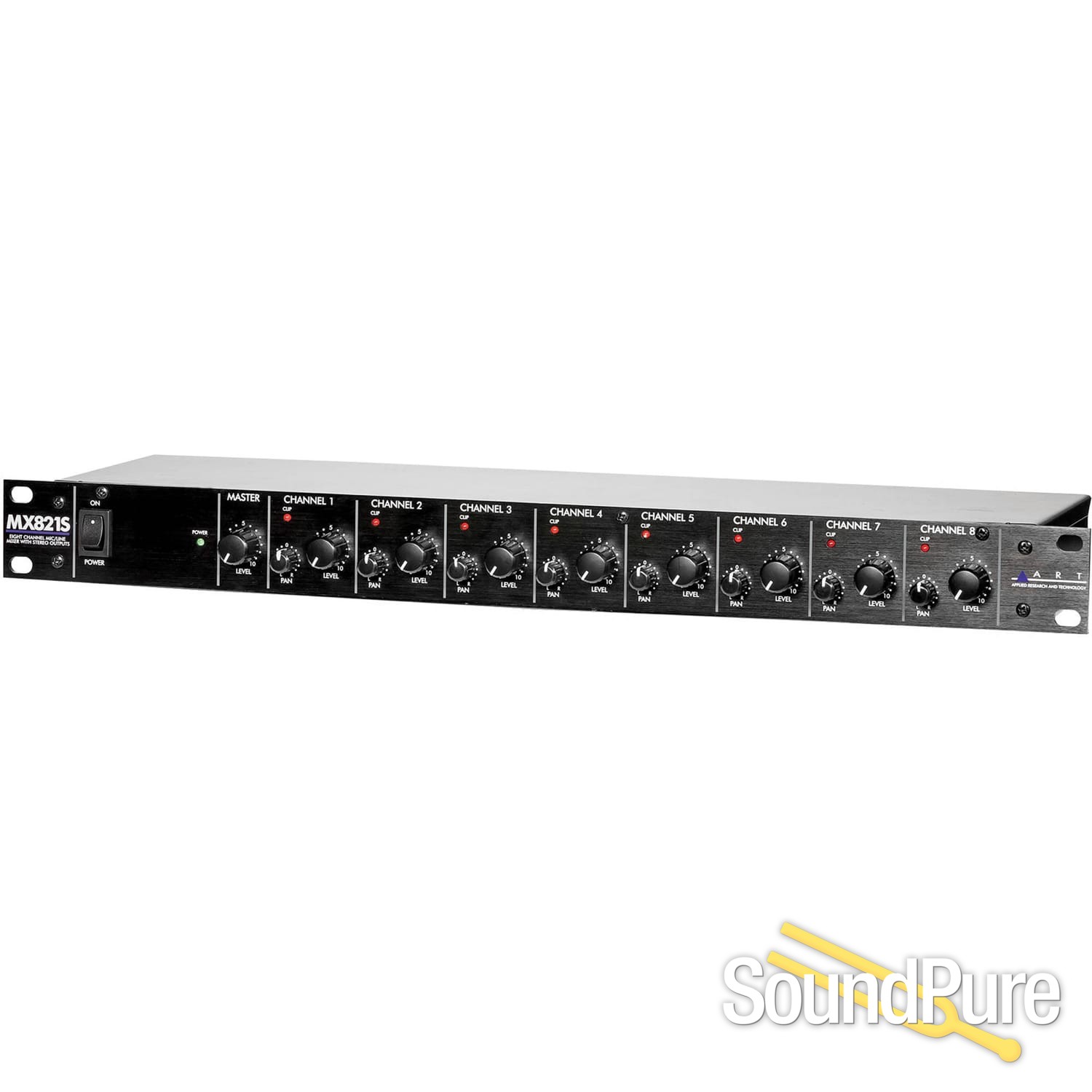
The ART MX821S is a versatile Definition of Rack:] body=[
| A 19-inch rack is a standardized frame or enclosure for mounting multiple equipment modules. Each module has a front panel that is 19 inches (480 mm) wide, including edges or ears that protrude on each side which allow the module to be fastened to the rack frame with screws. |
| In professional audio, a mixing console, or audio mixer, also called a sound board, soundboard, mixing desk, or mixer is an electronic device for combining (also called "mixing"), routing, and changing the level, timbre and/or dynamics of audio signals. A mixer can mix analog or digital signals, depending on the type of mixer. The modified signals (voltages or digital samples) are summed to produce the combined output signals. Mixing consoles are used in many applications, including recording studios, public address systems, sound reinforcement systems, broadcasting, television, and film post-production. An example of a simple application would be to enable the signals that originated from two separate microphones (each being used by vocalists singing a duet, perhaps) to be heard through one set of speakers simultaneously. When used for live performances, the signal produced by the mixer will usually be sent directly to an amplifier, unless that particular mixer is "powered" or it is being connected to powered speakers. |
| A functional path in an audio circuit (i.e. an input channel, an output channel, a recording channel, the left channel, right channel and so on. |
| Stereophonic sound, commonly called stereo, is the reproduction of sound using two or more independent audio channels through a symmetrical configuration of loudspeakers in such a way as to create the impression of sound heard from various directions, as in natural hearing. It is often contrasted with monophonic, or "mono" sound, where audio is in the form of one channel, often centered in the sound field (analogous to a visual field). |
| A functional path in an audio circuit (i.e. an input channel, an output channel, a recording channel, the left channel, right channel and so on. |
| An audio line comprising three conductors: two carrying signal and a ground (shield) wire, in which one of the signal wires carries the sound and the other carries an inverted copy. When the signal reaches the destination, the inverted copy is flipped and added to the original. Any noise that has been induced into the signal is also inverted. When this is combined with the "uninverted" noise, it cancels it out. Balanced lines thus are less susceptible to hum and can carry audio signals over longer distances. Balanced audio lines typically use 3-pin XLR or 1/4-inch tip-ring-sleeve, phone connectors. |
| The XLR connector is an electrical connector design. XLR plugs and sockets are used mostly in professional audio and video electronics cabling applications, often for microphones. Home audio and video electronics normally use RCA connectors for line level signals generated by a preamplifier. Phone plugs are also used for microphones in home and computer applications. |
| A microphone, colloquially called a mic or mike (both pronounced /ˈmaɪk/), is an acoustic-to-electric transducer or sensor that converts sound into an electrical signal. In 1876, Emile Berliner invented the first microphone used as a telephone voice transmitter. Microphones are used in many applications such as telephones, tape recorders, hearing aids, motion picture production, live and recorded audio engineering, in radio and television broadcasting and in computers for recording voice, VoIP, and for non-acoustic purposes such as ultrasonic checking. |
| In Electrical engineering, an unbalanced line is a transmission line, usually coaxial cable, whose conductors have unequal impedances with respect to ground; the opposite of a balanced line. |
| A unit of linear measure equal to one twelfth of a foot (2.54 cm). |
| A TRS connector (tip, ring, sleeve) also called an audio jack, phone jack, phone plug, jack plug, stereo plug, mini-jack, mini-stereo, or headphone jack, is a common analog audio connector. It is cylindrical in shape, typically with three contacts, although sometimes with two (a TS connector) or four (a TRRS connector). It was invented for use in telephone switchboards in the 20th century and is still widely used, both in its original 1/4" (exactly 6.35 mm) size and in miniaturized versions: 3.5 mm (approx. 1/8") and 2.5 mm (approx. 3/32"). The connector's name is an initialism derived from the names of three conducting parts of the plug: Tip, Ring, and Sleeve - hence, TRS. |
| Another word for signal voltage, power, strength or volume. Audio signals are sometimes classified according to their level. Commonly used levels in audio are: microphone level (-55 dBu), instrument level (-20 to -10 dBu), consumer line level (-10 dBu) and balanced professional line level (+4 to +30 dBu). |
| Another word for signal voltage, power, strength or volume. Audio signals are sometimes classified according to their level. Commonly used levels in audio are: microphone level (-55 dBu), instrument level (-20 to -10 dBu), consumer line level (-10 dBu) and balanced professional line level (+4 to +30 dBu). |
| Short for panoramic potentiometer. A pan pot (usually on the channel strip of audio mixer) is used to position a monaural sound source in a stereo mixing field by adjusting the source's volume between the left and right channels. Our brains sense stereo position by hearing this difference in loudness when the sound strikes each ear, taking into account time delay, spectrum, ambient reverberation and other cues. |
+48 Definition of Volt:] body=[
| A unit of measure of electromotive force (resulting from a difference in electrical potential) equal to the force required to produce a current of one ampere through an element having a resistance of one ohm. |
| A microphone, colloquially called a mic or mike (both pronounced /ˈmaɪk/), is an acoustic-to-electric transducer or sensor that converts sound into an electrical signal. In 1876, Emile Berliner invented the first microphone used as a telephone voice transmitter. Microphones are used in many applications such as telephones, tape recorders, hearing aids, motion picture production, live and recorded audio engineering, in radio and television broadcasting and in computers for recording voice, VoIP, and for non-acoustic purposes such as ultrasonic checking. |
| Mastering, a form of audio post-production, is the process of preparing and transferring recorded audio from a source containing the final mix to a data storage device (the Master); the source from which all copies will be produced (via methods such as pressing, duplication or replication). The format of choice these days is digital masters although analog masters, such as audio tapes, are still being used by the manufacturing industry and a few engineers who have specialized themselves in analog mastering. |
| Another word for signal voltage, power, strength or volume. Audio signals are sometimes classified according to their level. Commonly used levels in audio are: microphone level (-55 dBu), instrument level (-20 to -10 dBu), consumer line level (-10 dBu) and balanced professional line level (+4 to +30 dBu). |
| An audio line comprising three conductors: two carrying signal and a ground (shield) wire, in which one of the signal wires carries the sound and the other carries an inverted copy. When the signal reaches the destination, the inverted copy is flipped and added to the original. Any noise that has been induced into the signal is also inverted. When this is combined with the "uninverted" noise, it cancels it out. Balanced lines thus are less susceptible to hum and can carry audio signals over longer distances. Balanced audio lines typically use 3-pin XLR or 1/4-inch tip-ring-sleeve, phone connectors. |
| A unit of linear measure equal to one twelfth of a foot (2.54 cm). |
| A TRS connector (tip, ring, sleeve) also called an audio jack, phone jack, phone plug, jack plug, stereo plug, mini-jack, mini-stereo, or headphone jack, is a common analog audio connector. It is cylindrical in shape, typically with three contacts, although sometimes with two (a TS connector) or four (a TRRS connector). It was invented for use in telephone switchboards in the 20th century and is still widely used, both in its original 1/4" (exactly 6.35 mm) size and in miniaturized versions: 3.5 mm (approx. 1/8") and 2.5 mm (approx. 3/32"). The connector's name is an initialism derived from the names of three conducting parts of the plug: Tip, Ring, and Sleeve - hence, TRS. |
| Mastering, a form of audio post-production, is the process of preparing and transferring recorded audio from a source containing the final mix to a data storage device (the Master); the source from which all copies will be produced (via methods such as pressing, duplication or replication). The format of choice these days is digital masters although analog masters, such as audio tapes, are still being used by the manufacturing industry and a few engineers who have specialized themselves in analog mastering. |
| Another word for signal voltage, power, strength or volume. Audio signals are sometimes classified according to their level. Commonly used levels in audio are: microphone level (-55 dBu), instrument level (-20 to -10 dBu), consumer line level (-10 dBu) and balanced professional line level (+4 to +30 dBu). |
| An electrical bus (alternatively spelled "buss"), derived from busbar, is a common electrical connection between multiple electrical devices. A bus can either allow signals to be transferred between devices, the summing (mixing) of output signals from the devices or the distribution of input signals or power amongst the devices. A bus often takes the form of a wire or printed circuit conductor that terminate at multiple connectors which allows the devices to be plugged into the bus. |
| Sometimes referred to as an Phono connector, RCA connectors are generically known as pin jack connectors. Commonly used on home stereo equipment, the "phono" designation for these audio connectors comes from the fact that they are almost universally used for the outputs on phonographs. |
| Short for multiple. In audio work, a mult is a parallel connection (in a patch bay or with specially built cables or wiring) used to feed an output to more than one input. A "Y" cable is one type of mult connection. |
The ART MX821S may be used on stage, in the studio, or for permanent install applications including conference rooms, corporate boardrooms, churches, restaurants, small clubs, health clubs and more. A built-in Definition of Power:] body=[
| The rate at which electrical energy is applied to or taken from a device. It is expressed in terms of watts, milliwatts or microwatts. |
| A unit of linear measure equal to one twelfth of a foot (2.54 cm). |
| A 19-inch rack is a standardized frame or enclosure for mounting multiple equipment modules. Each module has a front panel that is 19 inches (480 mm) wide, including edges or ears that protrude on each side which allow the module to be fastened to the rack frame with screws. |
- Eight input channels with individual Definition of Level:] body=[
] cssheader=[boxoverheader] cssbody=[boxoverbody]">level and pan controlsAnother word for signal voltage, power, strength or volume. Audio signals are sometimes classified according to their level. Commonly used levels in audio are: microphone level (-55 dBu), instrument level (-20 to -10 dBu), consumer line level (-10 dBu) and balanced professional line level (+4 to +30 dBu). - Definition of Pan:] body=[
] cssheader=[boxoverheader] cssbody=[boxoverbody]">Pan controls place each input Definition of Mono:] body=[Short for panoramic potentiometer. A pan pot (usually on the channel strip of audio mixer) is used to position a monaural sound source in a stereo mixing field by adjusting the source's volume between the left and right channels. Our brains sense stereo position by hearing this difference in loudness when the sound strikes each ear, taking into account time delay, spectrum, ambient reverberation and other cues.
] cssheader=[boxoverheader] cssbody=[boxoverbody]">mono signal anywhere in the output Definition of Stereo:] body=[Monaural or monophonic sound reproduction (often shortened to mono) is single-channel. Typically there is only one microphone, one loudspeaker, or (in the case of headphones and multiple loudspeakers) channels are fed from a common signal path. In the case of multiple microphones the paths are mixed into a single signal path at some stage.
Monaural sound has been replaced by stereo sound in most entertainment applications. However, it remains the standard for radiotelephone communications, telephone networks, and induction loops for use with hearing aids.
] cssheader=[boxoverheader] cssbody=[boxoverbody]">stereo imageStereophonic sound, commonly called stereo, is the reproduction of sound using two or more independent audio channels through a symmetrical configuration of loudspeakers in such a way as to create the impression of sound heard from various directions, as in natural hearing. It is often contrasted with monophonic, or "mono" sound, where audio is in the form of one channel, often centered in the sound field (analogous to a visual field). - Definition of Balanced:] body=[
] cssheader=[boxoverheader] cssbody=[boxoverbody]">Balanced microphone Definition of XLR:] body=[An audio line comprising three conductors: two carrying signal and a ground (shield) wire, in which one of the signal wires carries the sound and the other carries an inverted copy. When the signal reaches the destination, the inverted copy is flipped and added to the original. Any noise that has been induced into the signal is also inverted. When this is combined with the "uninverted" noise, it cancels it out. Balanced lines thus are less susceptible to hum and can carry audio signals over longer distances. Balanced audio lines typically use 3-pin XLR or 1/4-inch tip-ring-sleeve, phone connectors.
] cssheader=[boxoverheader] cssbody=[boxoverbody]">XLR or Definition of Unbalanced:] body=[The XLR connector is an electrical connector design. XLR plugs and sockets are used mostly in professional audio and video electronics cabling applications, often for microphones. Home audio and video electronics normally use RCA connectors for line level signals generated by a preamplifier. Phone plugs are also used for microphones in home and computer applications.
] cssheader=[boxoverheader] cssbody=[boxoverbody]">unbalanced 1/4-Definition of Inch:] body=[In Electrical engineering, an unbalanced line is a transmission line, usually coaxial cable, whose conductors have unequal impedances with respect to ground; the opposite of a balanced line.
] cssheader=[boxoverheader] cssbody=[boxoverbody]">inch Definition of TS:] body=[A unit of linear measure equal to one twelfth of a foot (2.54 cm).
] cssheader=[boxoverheader] cssbody=[boxoverbody]">TS inputs on each Definition of Channel:] body=[A TRS connector (tip, ring, sleeve) also called an audio jack, phone jack, phone plug, jack plug, stereo plug, mini-jack, mini-stereo, or headphone jack, is a common analog audio connector. It is cylindrical in shape, typically with three contacts, although sometimes with two (a TS connector) or four (a TRRS connector).
It was invented for use in telephone switchboards in the 20th century and is still widely used, both in its original 1/4" (exactly 6.35 mm) size and in miniaturized versions: 3.5 mm (approx. 1/8") and 2.5 mm (approx. 3/32"). The connector's name is an initialism derived from the names of three conducting parts of the plug: Tip, Ring, and Sleeve - hence, TRS.
] cssheader=[boxoverheader] cssbody=[boxoverbody]">channelA functional path in an audio circuit (i.e. an input channel, an output channel, a recording channel, the left channel, right channel and so on. - Full +Definition of 48V:] body=[
] cssheader=[boxoverheader] cssbody=[boxoverbody]">48V low Definition of Noise:] body=[Phantom power (usually P48 or 48 volts in pro audio equipment, sometimes lower (e.g. 12 volts)) is a method that sends a DC electrical power through microphone cables to operate microphones that contain active electronic circuitry. It is best known as a common power source for condenser microphones, though many active DI boxes also use it.
Phantom power supplies are often built into mixing desks, microphone preamplifiers and similar equipment. In addition to powering the circuitry of a microphone, in traditional (DC-polarized) condenser microphones the phantom powering directly or indirectly supplies the voltage used for polarizing the microphone's transducer element ("capsule").
] cssheader=[boxoverheader] cssbody=[boxoverbody]">noise phantom Definition of Power:] body=[In sound production, noise can be classified as hum, buzz or hiss, crosstalk or digital hash.
] cssheader=[boxoverheader] cssbody=[boxoverbody]">power switchable for each Definition of Microphone:] body=[The rate at which electrical energy is applied to or taken from a device. It is expressed in terms of watts, milliwatts or microwatts.
] cssheader=[boxoverheader] cssbody=[boxoverbody]">microphone inputA microphone, colloquially called a mic or mike (both pronounced /ˈmaɪk/), is an acoustic-to-electric transducer or sensor that converts sound into an electrical signal. In 1876, Emile Berliner invented the first microphone used as a telephone voice transmitter. Microphones are used in many applications such as telephones, tape recorders, hearing aids, motion picture production, live and recorded audio engineering, in radio and television broadcasting and in computers for recording voice, VoIP, and for non-acoustic purposes such as ultrasonic checking. - Definition of Balanced:] body=[
] cssheader=[boxoverheader] cssbody=[boxoverbody]">Balanced left and right 1/4-Definition of Inch:] body=[An audio line comprising three conductors: two carrying signal and a ground (shield) wire, in which one of the signal wires carries the sound and the other carries an inverted copy. When the signal reaches the destination, the inverted copy is flipped and added to the original. Any noise that has been induced into the signal is also inverted. When this is combined with the "uninverted" noise, it cancels it out. Balanced lines thus are less susceptible to hum and can carry audio signals over longer distances. Balanced audio lines typically use 3-pin XLR or 1/4-inch tip-ring-sleeve, phone connectors.
] cssheader=[boxoverheader] cssbody=[boxoverbody]">inch Definition of TRS:] body=[A unit of linear measure equal to one twelfth of a foot (2.54 cm).
] cssheader=[boxoverheader] cssbody=[boxoverbody]">TRS main output jacks with Definition of Master:] body=[A TRS connector (tip, ring, sleeve) also called an audio jack, phone jack, phone plug, jack plug, stereo plug, mini-jack, mini-stereo, or headphone jack, is a common analog audio connector. It is cylindrical in shape, typically with three contacts, although sometimes with two (a TS connector) or four (a TRRS connector).
It was invented for use in telephone switchboards in the 20th century and is still widely used, both in its original 1/4" (exactly 6.35 mm) size and in miniaturized versions: 3.5 mm (approx. 1/8") and 2.5 mm (approx. 3/32"). The connector's name is an initialism derived from the names of three conducting parts of the plug: Tip, Ring, and Sleeve - hence, TRS.
] cssheader=[boxoverheader] cssbody=[boxoverbody]">master Definition of Level:] body=[Mastering, a form of audio post-production, is the process of preparing and transferring recorded audio from a source containing the final mix to a data storage device (the Master); the source from which all copies will be produced (via methods such as pressing, duplication or replication). The format of choice these days is digital masters although analog masters, such as audio tapes, are still being used by the manufacturing industry and a few engineers who have specialized themselves in analog mastering.
] cssheader=[boxoverheader] cssbody=[boxoverbody]">level controlAnother word for signal voltage, power, strength or volume. Audio signals are sometimes classified according to their level. Commonly used levels in audio are: microphone level (-55 dBu), instrument level (-20 to -10 dBu), consumer line level (-10 dBu) and balanced professional line level (+4 to +30 dBu). - Prefade Output jacks and Aux Definition of Bus:] body=[
] cssheader=[boxoverheader] cssbody=[boxoverbody]">Bus Input jacks allow units to be chained to provide extra inputsAn electrical bus (alternatively spelled "buss"), derived from busbar, is a common electrical connection between multiple electrical devices.
A bus can either allow signals to be transferred between devices, the summing (mixing) of output signals from the devices or the distribution of input signals or power amongst the devices. A bus often takes the form of a wire or printed circuit conductor that terminate at multiple connectors which allows the devices to be plugged into the bus. - Each line input Definition of Jack:] body=[
] cssheader=[boxoverheader] cssbody=[boxoverbody]">jack may be individually converted to a direct line output by means of internal jumpersIn electronics and electrical assemblies, the term jack commonly refers to a surface-mounted connector, often with the female electrical contact or socket, and is the "more fixed" connector of a connector pair. The related term "jack plug" commonly refers to a "less fixed" connector of a connector pair, often with the male electrical contact or pin, and is generally shortened to simply "plug." - Rugged Definition of 1U:] body=[
] cssheader=[boxoverheader] cssbody=[boxoverbody]">1U Definition of Rack-Mount:] body=[A rack unit or U (less commonly, RU) is a unit of measure used to describe the height of equipment intended for mounting in a 19-inch rack or a 23-inch rack (The dimension refers to the width of the equipment mounting frame in the rack i.e. the width of the equipment that can be mounted inside the rack). One rack unit is 1.75 inches (44.45 mm) high.
The size of a piece of rack mounted equipment is frequently described as a number in "U". For example, one rack unit is often referred to as "1U", 2 rack units as "2U" and so on.
] cssheader=[boxoverheader] cssbody=[boxoverbody]">rack-mount steel chassis with built-in Definition of Power:] body=[Designed to be installed in a framework called a rack. The rack contains multiple mounting slots called bays, each designed to hold a hardware unit secured in place with screws.
] cssheader=[boxoverheader] cssbody=[boxoverbody]">power supplyThe rate at which electrical energy is applied to or taken from a device. It is expressed in terms of watts, milliwatts or microwatts. - Perfect for Definition of Stage:] body=[
] cssheader=[boxoverheader] cssbody=[boxoverbody]">stage, studio and permanent installationsIn theatre, the stage (sometimes referred to as the deck in stagecraft) is a designated space for the performance of theatrical productions. The stage serves as a space for actors or performers and a focal point for the members of the audience. As an architectural feature, the stage may consist of a platform (often raised) or series of platforms. In some cases, these may be temporary or adjustable but in theaters and other buildings devoted to such productions, the stage is often a permanent feature.
There are several types of stages that vary as to the usage and the relation of the audience to them. The most common form found in the West is the proscenium stage. In this type, the audience is located on one side of the stage with the remaining sides hidden and used by the performers and technicians. Thrust stages may be similar to proscenium stages but with a platform or performance area that extends into the audience space so that the audience is located on three sides. In theatre in the round, the audience is located on all four sides of the stage. The fourth type of stage incorporates created and found stages which may be constructed specifically for a performance or may involve a space that is adapted as a stage.
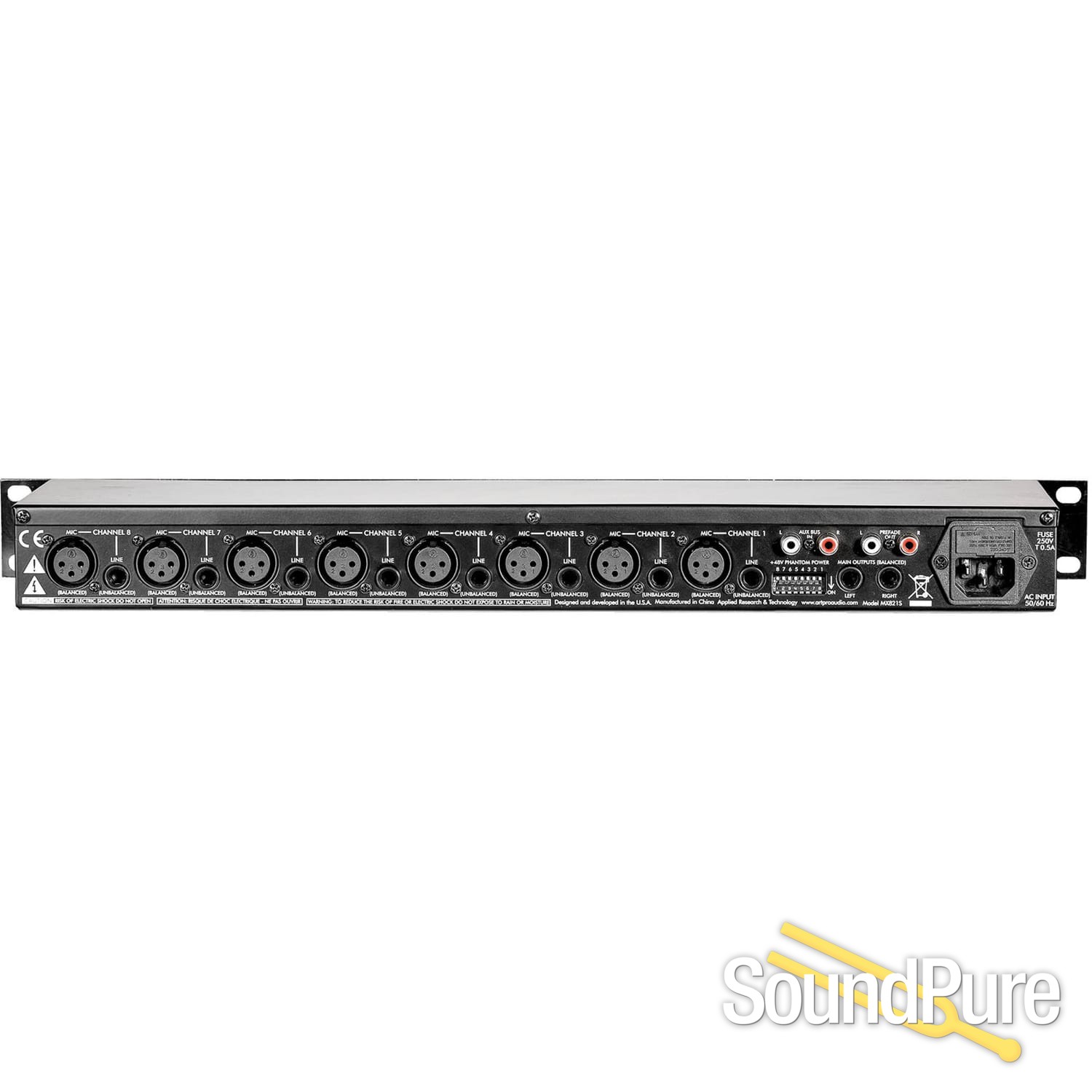
- INPUT CONNECTIONS
- Definition of XLR:] body=[ The XLR connector is an electrical connector design. XLR plugs and sockets are used mostly in professional audio and video electronics cabling applications, often for microphones. Home audio and video electronics normally use RCA connectors for line level signals generated by a preamplifier. Phone plugs are also used for microphones in home and computer applications.] cssheader=[boxoverheader] cssbody=[boxoverbody]">XLR female balanced (Mic, channels 1-8) 1/4-Definition of Inch:] body=[ A unit of linear measure equal to one twelfth of a foot (2.54 cm).] cssheader=[boxoverheader] cssbody=[boxoverbody]">inch Definition of TS:] body=[ A TRS connector (tip, ring, sleeve) also called an audio jack, phone jack, phone plug, jack plug, stereo plug, mini-jack, mini-stereo, or headphone jack, is a common analog audio connector. It is cylindrical in shape, typically with three contacts, although sometimes with two (a TS connector) or four (a TRRS connector). It was invented for use in telephone switchboards in the 20th century and is still widely used, both in its original 1/4" (exactly 6.35 mm) size and in miniaturized versions: 3.5 mm (approx. 1/8") and 2.5 mm (approx. 3/32"). The connector's name is an initialism derived from the names of three conducting parts of the plug: Tip, Ring, and Sleeve - hence, TRS.] cssheader=[boxoverheader] cssbody=[boxoverbody]">TS unbalanced (Line, channels 1-8) Definition of RCA:] body=[ Sometimes referred to as an Phono connector, RCA connectors are generically known as pin jack connectors. Commonly used on home stereo equipment, the "phono" designation for these audio connectors comes from the fact that they are almost universally used for the outputs on phonographs.] cssheader=[boxoverheader] cssbody=[boxoverbody]">RCA Definition of Unbalanced:] body=[ In Electrical engineering, an unbalanced line is a transmission line, usually coaxial cable, whose conductors have unequal impedances with respect to ground; the opposite of a balanced line.] cssheader=[boxoverheader] cssbody=[boxoverbody]">unbalanced (Aux Definition of Bus:] body=[ An electrical bus (alternatively spelled "buss"), derived from busbar, is a common electrical connection between multiple electrical devices. A bus can either allow signals to be transferred between devices, the summing (mixing) of output signals from the devices or the distribution of input signals or power amongst the devices. A bus often takes the form of a wire or printed circuit conductor that terminate at multiple connectors which allows the devices to be plugged into the bus.] cssheader=[boxoverheader] cssbody=[boxoverbody]">Bus In, Left and Right)
- OUTPUT CONNECTIONS
- 1/4-Definition of Inch:] body=[ A unit of linear measure equal to one twelfth of a foot (2.54 cm).] cssheader=[boxoverheader] cssbody=[boxoverbody]">inch Definition of TRS:] body=[ A TRS connector (tip, ring, sleeve) also called an audio jack, phone jack, phone plug, jack plug, stereo plug, mini-jack, mini-stereo, or headphone jack, is a common analog audio connector. It is cylindrical in shape, typically with three contacts, although sometimes with two (a TS connector) or four (a TRRS connector). It was invented for use in telephone switchboards in the 20th century and is still widely used, both in its original 1/4" (exactly 6.35 mm) size and in miniaturized versions: 3.5 mm (approx. 1/8") and 2.5 mm (approx. 3/32"). The connector's name is an initialism derived from the names of three conducting parts of the plug: Tip, Ring, and Sleeve - hence, TRS.] cssheader=[boxoverheader] cssbody=[boxoverbody]">TRS balanced (Main Outputs, Left and Right) Definition of RCA:] body=[ Sometimes referred to as an Phono connector, RCA connectors are generically known as pin jack connectors. Commonly used on home stereo equipment, the "phono" designation for these audio connectors comes from the fact that they are almost universally used for the outputs on phonographs.] cssheader=[boxoverheader] cssbody=[boxoverbody]">RCA Definition of Unbalanced:] body=[ In Electrical engineering, an unbalanced line is a transmission line, usually coaxial cable, whose conductors have unequal impedances with respect to ground; the opposite of a balanced line.] cssheader=[boxoverheader] cssbody=[boxoverbody]">unbalanced (Prefade Out, Left and Right)
- INPUT IMPEDANCE
- 2k Definition of Ohms:] body=[ The unit by which resistance to electrical current is measured. From Ohm's Law (Current=Voltage/Resistance, or in other words, Current=Voltage/Ohms), a mathematical expression of the relationship between these three elements. It is also symbolized by the Greek capital letter omega (Ω).] cssheader=[boxoverheader] cssbody=[boxoverbody]">Ohms (Definition of Mic:] body=[ A microphone, colloquially called a mic or mike (both pronounced /ˈmaɪk/), is an acoustic-to-electric transducer or sensor that converts sound into an electrical signal. In 1876, Emile Berliner invented the first microphone used as a telephone voice transmitter. Microphones are used in many applications such as telephones, tape recorders, hearing aids, motion picture production, live and recorded audio engineering, in radio and television broadcasting and in computers for recording voice, VoIP, and for non-acoustic purposes such as ultrasonic checking.] cssheader=[boxoverheader] cssbody=[boxoverbody]">Mic), 20k Definition of Ohms:] body=[ The unit by which resistance to electrical current is measured. From Ohm's Law (Current=Voltage/Resistance, or in other words, Current=Voltage/Ohms), a mathematical expression of the relationship between these three elements. It is also symbolized by the Greek capital letter omega (Ω).] cssheader=[boxoverheader] cssbody=[boxoverbody]">Ohms (Line), 51k Definition of Ohms:] body=[ The unit by which resistance to electrical current is measured. From Ohm's Law (Current=Voltage/Resistance, or in other words, Current=Voltage/Ohms), a mathematical expression of the relationship between these three elements. It is also symbolized by the Greek capital letter omega (Ω).] cssheader=[boxoverheader] cssbody=[boxoverbody]">Ohms (Aux Definition of Bus:] body=[ An electrical bus (alternatively spelled "buss"), derived from busbar, is a common electrical connection between multiple electrical devices. A bus can either allow signals to be transferred between devices, the summing (mixing) of output signals from the devices or the distribution of input signals or power amongst the devices. A bus often takes the form of a wire or printed circuit conductor that terminate at multiple connectors which allows the devices to be plugged into the bus.] cssheader=[boxoverheader] cssbody=[boxoverbody]">Bus In)
- OUTPUT Definition of Impedance
- ] body=[ Electrical impedance, or simply impedance, describes a measure of opposition to alternating current (AC). Electrical impedance extends the concept of resistance to AC circuits, describing not only the relative amplitudes of the voltage and current, but also the relative phases. When the circuit is driven with direct current (DC) there is no distinction between impedance and resistance; the latter can be thought of as impedance with zero phase angle.] cssheader=[boxoverheader] cssbody=[boxoverbody]">IMPEDANCE: 200 Definition of Ohms:] body=[ The unit by which resistance to electrical current is measured. From Ohm's Law (Current=Voltage/Resistance, or in other words, Current=Voltage/Ohms), a mathematical expression of the relationship between these three elements. It is also symbolized by the Greek capital letter omega (Ω).] cssheader=[boxoverheader] cssbody=[boxoverbody]">Ohms (Main Outputs, Definition of Balanced:] body=[ An audio line comprising three conductors: two carrying signal and a ground (shield) wire, in which one of the signal wires carries the sound and the other carries an inverted copy. When the signal reaches the destination, the inverted copy is flipped and added to the original. Any noise that has been induced into the signal is also inverted. When this is combined with the "uninverted" noise, it cancels it out. Balanced lines thus are less susceptible to hum and can carry audio signals over longer distances. Balanced audio lines typically use 3-pin XLR or 1/4-inch tip-ring-sleeve, phone connectors.] cssheader=[boxoverheader] cssbody=[boxoverbody]">balanced), 100 Definition of Ohms:] body=[ The unit by which resistance to electrical current is measured. From Ohm's Law (Current=Voltage/Resistance, or in other words, Current=Voltage/Ohms), a mathematical expression of the relationship between these three elements. It is also symbolized by the Greek capital letter omega (Ω).] cssheader=[boxoverheader] cssbody=[boxoverbody]">Ohms (Prefade Out)
- Definition of Frequency
- ] body=[ The number of times a periodic waveform cycles, or repeats, over a period of time.] cssheader=[boxoverheader] cssbody=[boxoverbody]">FREQUENCY RESPONSE: 20 Definition of Hz:] body=[ A unit of measure of the frequency of a vibrating object, such as a guitar string, speaker cone or electrical signal. Equivalent to cycles per second, it is named for Heinrich Hertz and abbreviated "Hz."] cssheader=[boxoverheader] cssbody=[boxoverbody]">Hz - 20 Definition of kHz:] body=[ Kilohertz, 1,000 Hertz, or one thousand cycles per second.] cssheader=[boxoverheader] cssbody=[boxoverbody]">kHz (+0, -1 Definition of dB:] body=[ The decibel (dB) is a logarithmic unit of measurement that expresses the magnitude of a physical quantity (usually power or intensity) relative to a specified or implied reference level. Since it expresses a ratio of two (same unit) quantities, it is a dimensionless unit. A decibel is one tenth of a bel (B).We perceive loudness of sound as the logarithm of the actual sound intensity, and dB (decibels) are a logarithmic scale.] cssheader=[boxoverheader] cssbody=[boxoverbody]">dB) (CH 1-8 in, M
- TOTAL Definition of Harmonic
- ] body=[ Multiples of the fundamental sine wave frequency. A 50Hz sine wave has a second harmonic at 100Hz, a third harmonic at 150Hz, a fourth harmonic at 200Hz, a fifth harmonic at 250Hz and so on. The timbre of a musical instrument is defined by the complex mix of harmonics overlain on each note. In amplifiers, harmonic distortion is the addition of unwanted harmonics to the signal. Total Harmonic Distortion (THD) is the summation of all harmonic distortions.] cssheader=[boxoverheader] cssbody=[boxoverbody]">HARMONIC Definition of Distortion:] body=[ Change in the form of an electrical signal or sound wave during processing.] cssheader=[boxoverheader] cssbody=[boxoverbody]">DISTORTION: <0.01% @ 1 Definition of kHz:] body=[ Kilohertz, 1,000 Hertz, or one thousand cycles per second.] cssheader=[boxoverheader] cssbody=[boxoverbody]">kHz, typical
- Definition of Phase
- ] body=[ ("In-phase/Out-of-phase") Actually refers to the polarity of an electrical or acoustic signal. If two or more signals or devices are "out-of-phase" with respect to each other, cancellation or other disturbance of the combined output can result. Some examples of operating phase (polarity) definitions: "Positive sound pressure causes positive output" (microphones) or "positive input causes positive acoustic output" (speakers).] cssheader=[boxoverheader] cssbody=[boxoverbody]">PHASE RESPONSE: All connections are Definition of Phase:] body=[ ("In-phase/Out-of-phase") Actually refers to the polarity of an electrical or acoustic signal. If two or more signals or devices are "out-of-phase" with respect to each other, cancellation or other disturbance of the combined output can result. Some examples of operating phase (polarity) definitions: "Positive sound pressure causes positive output" (microphones) or "positive input causes positive acoustic output" (speakers).] cssheader=[boxoverheader] cssbody=[boxoverbody]">phase coherent
- SIGNAL TO Definition of Noise
- ] body=[ In sound production, noise can be classified as hum, buzz or hiss, crosstalk or digital hash.] cssheader=[boxoverheader] cssbody=[boxoverbody]">NOISE RATIO: >99dB typical (Ref 0dBu)
- CMRR
- >43 Definition of dB:] body=[ The decibel (dB) is a logarithmic unit of measurement that expresses the magnitude of a physical quantity (usually power or intensity) relative to a specified or implied reference level. Since it expresses a ratio of two (same unit) quantities, it is a dimensionless unit. A decibel is one tenth of a bel (B).We perceive loudness of sound as the logarithm of the actual sound intensity, and dB (decibels) are a logarithmic scale.] cssheader=[boxoverheader] cssbody=[boxoverbody]">dB typical
- MAXIMUM INPUT Definition of Level
- ] body=[ Another word for signal voltage, power, strength or volume. Audio signals are sometimes classified according to their level. Commonly used levels in audio are: microphone level (-55 dBu), instrument level (-20 to -10 dBu), consumer line level (-10 dBu) and balanced professional line level (+4 to +30 dBu).] cssheader=[boxoverheader] cssbody=[boxoverbody]">LEVEL: -4 Definition of dBu:] body=[ Decibels referred to the voltage equivalent of 0 dBm into a 600 ohm load. 1 dBu = 0.775v = -2.21 dBV] cssheader=[boxoverheader] cssbody=[boxoverbody]">dBu (Definition of Mic:] body=[ A microphone, colloquially called a mic or mike (both pronounced /ˈmaɪk/), is an acoustic-to-electric transducer or sensor that converts sound into an electrical signal. In 1876, Emile Berliner invented the first microphone used as a telephone voice transmitter. Microphones are used in many applications such as telephones, tape recorders, hearing aids, motion picture production, live and recorded audio engineering, in radio and television broadcasting and in computers for recording voice, VoIP, and for non-acoustic purposes such as ultrasonic checking.] cssheader=[boxoverheader] cssbody=[boxoverbody]">Mic), +22 Definition of dBu:] body=[ Decibels referred to the voltage equivalent of 0 dBm into a 600 ohm load. 1 dBu = 0.775v = -2.21 dBV] cssheader=[boxoverheader] cssbody=[boxoverbody]">dBu (Line)
- MAXIMUM OUTPUT Definition of Level
- ] body=[ Another word for signal voltage, power, strength or volume. Audio signals are sometimes classified according to their level. Commonly used levels in audio are: microphone level (-55 dBu), instrument level (-20 to -10 dBu), consumer line level (-10 dBu) and balanced professional line level (+4 to +30 dBu).] cssheader=[boxoverheader] cssbody=[boxoverbody]">LEVEL: +24 Definition of dBu:] body=[ Decibels referred to the voltage equivalent of 0 dBm into a 600 ohm load. 1 dBu = 0.775v = -2.21 dBV] cssheader=[boxoverheader] cssbody=[boxoverbody]">dBu (Definition of Balanced:] body=[ An audio line comprising three conductors: two carrying signal and a ground (shield) wire, in which one of the signal wires carries the sound and the other carries an inverted copy. When the signal reaches the destination, the inverted copy is flipped and added to the original. Any noise that has been induced into the signal is also inverted. When this is combined with the "uninverted" noise, it cancels it out. Balanced lines thus are less susceptible to hum and can carry audio signals over longer distances. Balanced audio lines typically use 3-pin XLR or 1/4-inch tip-ring-sleeve, phone connectors.] cssheader=[boxoverheader] cssbody=[boxoverbody]">balanced), +18 Definition of dBu:] body=[ Decibels referred to the voltage equivalent of 0 dBm into a 600 ohm load. 1 dBu = 0.775v = -2.21 dBV] cssheader=[boxoverheader] cssbody=[boxoverbody]">dBu (unbalanced)
- MAXIMUM Definition of Gain
- ] body=[ A ratio expressing the difference between the input and output power, level or current in a circuit.] cssheader=[boxoverheader] cssbody=[boxoverbody]">GAIN: 54 Definition of dB:] body=[ The decibel (dB) is a logarithmic unit of measurement that expresses the magnitude of a physical quantity (usually power or intensity) relative to a specified or implied reference level. Since it expresses a ratio of two (same unit) quantities, it is a dimensionless unit. A decibel is one tenth of a bel (B).We perceive loudness of sound as the logarithm of the actual sound intensity, and dB (decibels) are a logarithmic scale.] cssheader=[boxoverheader] cssbody=[boxoverbody]">dB (Definition of Mic:] body=[ A microphone, colloquially called a mic or mike (both pronounced /ˈmaɪk/), is an acoustic-to-electric transducer or sensor that converts sound into an electrical signal. In 1876, Emile Berliner invented the first microphone used as a telephone voice transmitter. Microphones are used in many applications such as telephones, tape recorders, hearing aids, motion picture production, live and recorded audio engineering, in radio and television broadcasting and in computers for recording voice, VoIP, and for non-acoustic purposes such as ultrasonic checking.] cssheader=[boxoverheader] cssbody=[boxoverbody]">Mic), 29 Definition of dB:] body=[ The decibel (dB) is a logarithmic unit of measurement that expresses the magnitude of a physical quantity (usually power or intensity) relative to a specified or implied reference level. Since it expresses a ratio of two (same unit) quantities, it is a dimensionless unit. A decibel is one tenth of a bel (B).We perceive loudness of sound as the logarithm of the actual sound intensity, and dB (decibels) are a logarithmic scale.] cssheader=[boxoverheader] cssbody=[boxoverbody]">dB (Line)
- Definition of Phantom Power
- ] body=[ Phantom power (usually P48 or 48 volts in pro audio equipment, sometimes lower (e.g. 12 volts)) is a method that sends a DC electrical power through microphone cables to operate microphones that contain active electronic circuitry. It is best known as a common power source for condenser microphones, though many active DI boxes also use it. Phantom power supplies are often built into mixing desks, microphone preamplifiers and similar equipment. In addition to powering the circuitry of a microphone, in traditional (DC-polarized) condenser microphones the phantom powering directly or indirectly supplies the voltage used for polarizing the microphone's transducer element ("capsule").] cssheader=[boxoverheader] cssbody=[boxoverbody]">PHANTOM Definition of Power:] body=[ The rate at which electrical energy is applied to or taken from a device. It is expressed in terms of watts, milliwatts or microwatts.] cssheader=[boxoverheader] cssbody=[boxoverbody]">POWER: Switch Selectable, +Definition of 48V:] body=[ Phantom power (usually P48 or 48 volts in pro audio equipment, sometimes lower (e.g. 12 volts)) is a method that sends a DC electrical power through microphone cables to operate microphones that contain active electronic circuitry. It is best known as a common power source for condenser microphones, though many active DI boxes also use it. Phantom power supplies are often built into mixing desks, microphone preamplifiers and similar equipment. In addition to powering the circuitry of a microphone, in traditional (DC-polarized) condenser microphones the phantom powering directly or indirectly supplies the voltage used for polarizing the microphone's transducer element ("capsule").] cssheader=[boxoverheader] cssbody=[boxoverbody]">48V Definition of DC:] body=[ Direct current (DC) is the unidirectional flow of electric charge. Direct current is produced by such sources as batteries, thermocouples, solar cells, and commutator-type electric machines of the dynamo type. Direct current may flow in a conductor such as a wire, but can also be through semiconductors, insulators, or even through a vacuum as in electron or ion beams. The electric charge flow in a constant direction, distinguishing it from alternating current (AC). A term formerly used for direct current was Galvanic current.] cssheader=[boxoverheader] cssbody=[boxoverbody]">DC (regulated and filtered), 7 mA Definition of Current:] body=[ The organized migration of electrons through a circuit or conductive material, as the result of an applied voltage and the presence of resistance.] cssheader=[boxoverheader] cssbody=[boxoverbody]">current limiting per leg
- Definition of Power
- ] body=[ The rate at which electrical energy is applied to or taken from a device. It is expressed in terms of watts, milliwatts or microwatts.] cssheader=[boxoverheader] cssbody=[boxoverbody]">POWER REQUIREMENTS: USA: 95-125 VAC, 50-60 Definition of Hz:] body=[ A unit of measure of the frequency of a vibrating object, such as a guitar string, speaker cone or electrical signal. Equivalent to cycles per second, it is named for Heinrich Hertz and abbreviated "Hz."] cssheader=[boxoverheader] cssbody=[boxoverbody]">Hz, <15W
- DIMENSIONS
- 1.75" x 19" x 6" (4.5cm x 48.3cm x 15.2cm)
- WEIGHT
- 6.3 lbs. (2.9 kg)
Free 3-Year Warranty
In addition to the standard included manufacturer warranty, virtually all new products carry our exclusive, industry-leading, absolutely free Sound Pure 3-Year Warranty, which includes parts and labor. It's our way of adding real value to the personal touch our small, dedicated team brings to every purchase.
Coverage exclusions live in Terms & Conditions, Section 27. Read the warranty →
You may also like
Browse Analog Mixing Consoles →


Sound Pure Studios · Durham, NC
Come hear it in our control rooms.
Sound Pure is a working studio in Durham, NC — a 1,000 sq ft live room and two pro control rooms. Book a session to audition gear in a world-class acoustic space before you buy.