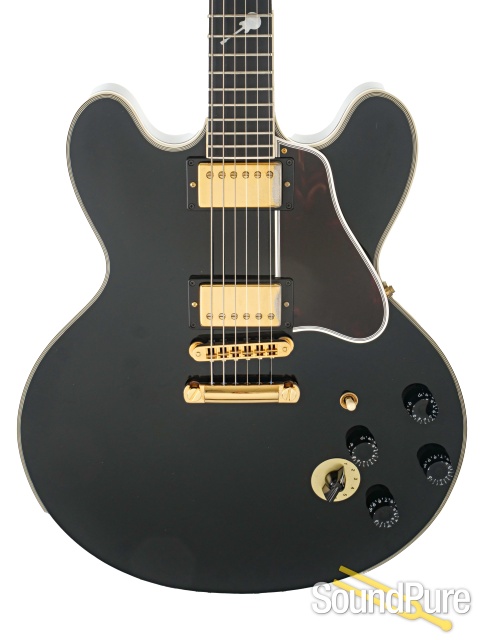
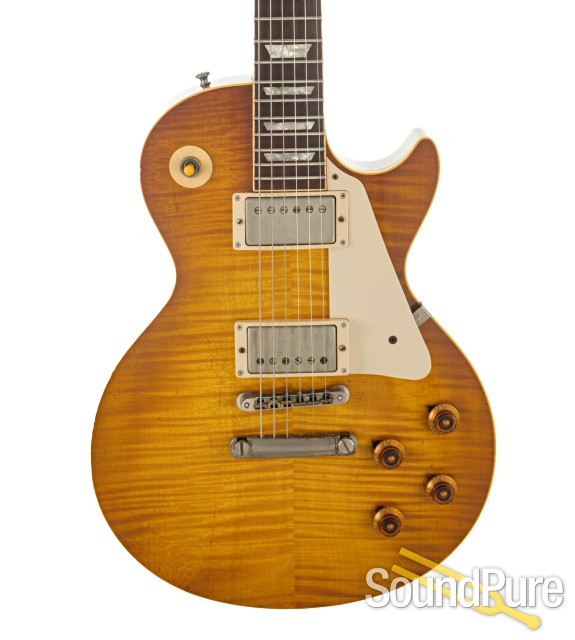
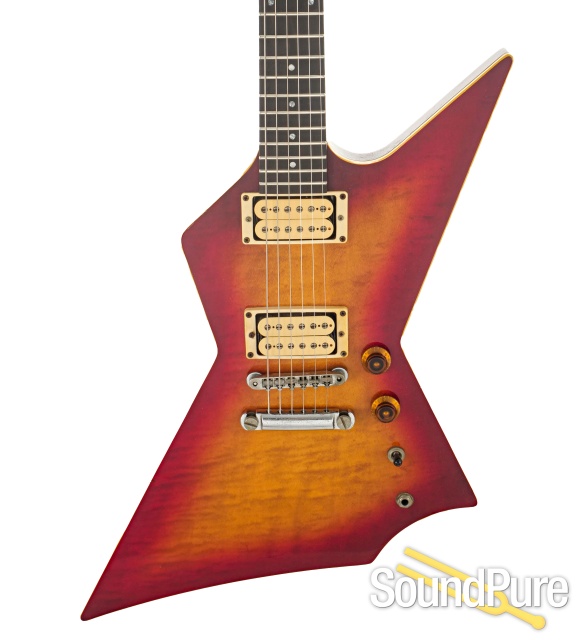
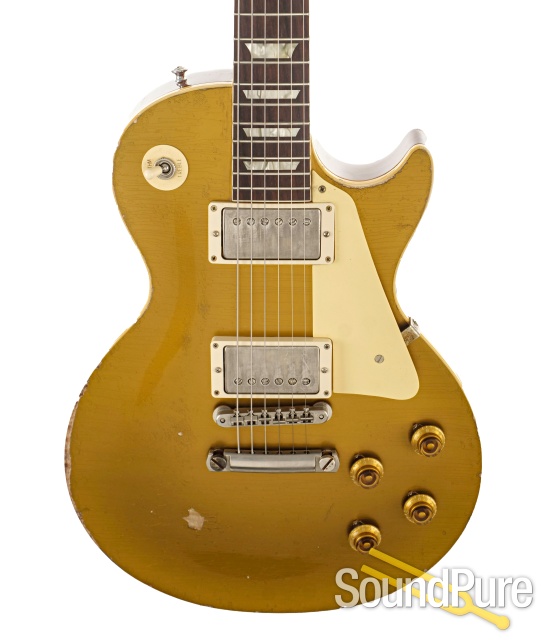
The home of Gibson electric guitars today is "Gibson USA," built in 1974 in Nashville specifically for the production of Gibson's Les Paul guitars. Although the entire guitar industry went through a slump in the late '70s, the spirit of innovation remained strong at Gibson. In response to a growing demand for vintage stylings, Gibson tapped its rich history and reissued the dot-neck version of the ES-335 in 1981 and the flametop sunburst Les Paul in 1982. At the same time, two legendary guitarists joined Gibson- B.B. King in 1980 with the Lucille model and Chet Atkins in 1982 with his new concept of a solidbody acoustic guitar.
Gibson world headquarters moved to Nashville in 1984 with the closing of the Kalamazoo plant. The financially troubled company was rescued in January 1986 by Henry Juszkiewicz and David Berryman, and the new owners quickly restored Gibson's reputation for quality as well as its profitability.
Today's Gibson electric guitars represent the history as well as the future of the electric guitar. The models whose designs have become classics-the ES-175, ES-335, Flying V, Explorer, Firebird, SGs and Les Pauls-are a testament to Gibson's wide appeal, spanning more than four decades of music styles. Gibson's close relationship with musicians is manifest in endorsement models from King, Atkins and jazz greats Howard Roberts and Herb Ellis, plus new Les Pauls made to the personal specifications of rock stars Jimmy Page and Joe Perry. In 1994, Gibson's Centennial year, the new Nighthawk model won an industry award for design, setting the stage for a second hundred years of Gibson quality and innovation.
By the time Gibson began work on its first electric guitar, the company had a 40-year tradition of quality and innovation to uphold. The first Gibson electric had to be nothing less than the best electric guitar the world had ever seen.
In the spring of 1935, Gibson enlisted musician Alvino Rey to help develop a prototype pickup with engineers at the Lyon & Healy company in Chicago. Later that year, research was moved in-house, where Gibson employee Walter Fuller came up with the final design. Gibson introduced the distinctive hexagonal pickup on a lap steel model in late 1935. The pickup was installed on an F-hole archtop guitar, dubbed the ES-150 ES for Electric Spanish), and the first one shipped from the Gibson factory in Kalamazoo, Michigan, on May 20, 1936.
Was the ES-150 the best electric guitar that guitarists in 1936 had ever seen? Jazz musician Charlie Christian, who would establish the electric guitar as an instrument with its own unique voice, thought so. Sixty years later, the Gibson ES-150 is still known as the Charlie Christian model, and some jazz players consider the ES-150's "Charlie Christian" pickup to be the best jazz pickup ever made.
The ES-150's success was a double-edged sword, establishing Gibson as the foremost maker of electric guitars but at the same time challenging Gibson to top this monumental achievement. After a production break for World War II, Gibson did just that.
In the years after World War II, the electric guitar came of age and Gibson entered a golden of age of innovation. The P-90 pickup, introduced in 1946, gave guitarists new power and versatility. Under the aggressive leadership of company president Ted McCarty, Gibson debuted two new concepts in 1949 with the ES-5, the first three-pickup guitar, and the ES-175, the first guitar with a sharply pointed cutaway bout.
The advent of the solidbody electric guitar posed a new challenge for Gibson. Like the ES-150 in 1936, Gibson's first solidbody electric had to uphold Gibson tradition while going a step beyond all other guitars of its kind. A carved contoured top harkened back to the very first Orville Gibson instruments of the late 1800s, and a gold finish signified a value above all others. With the endorsement of the most popular guitarist of the time, Gibson introduced the Les Paul Model in 1952. The Les Paul quickly grew into a family of four models-the Junior, Special, Standard and Custom - all of which would become Gibson classics. Gibson's top models sported McCarty's new tune-o-matic bridge, which was introduced on the Les Paul Custom in 1954 and is still the standard Gibson electric guitar bridge. In 1958 McCarty debuted not one, but two radical new ideas-a semi-hollowbody electric and a group of exotic, futuristic solidbodies. The ES-335 was an instant success, combining traditional archtop styling with modern, solidbody construction. The Flying V, Explorer and Moderne proved to be decades ahead of their time.
Gibson pushed on into the 1960s with two more bold, modern solidbody lines-the double-cutaway SG models of '61 and the reverse-body Firebirds of '63. By the time the McCarty era ended in 1965, a foundation of classic models had been laid that would carry Gibson through the rest of the century.